Most small businesses are about to put their most important knowledge in the wrong place.
The AI model is not your business. Your client history, your processes, your pricing notes, your follow-up habits, your exceptions: that is your business. And right now, for a lot of small businesses, that knowledge is scattered across chat transcripts, spreadsheets, and one employee's memory.
There are two different things being sold under the name AI, and the difference matters more than which model is smartest.
The model, whether ChatGPT, Claude, or Gemini, is rented intelligence. It can reason, write, analyze, and build. It is powerful, it keeps getting cheaper, and every provider is roughly one release away from leapfrogging the others. On consumer plans, what you paste into a chat may be used to train or improve future models unless you turn that setting off. That is not a scandal. It is the deal. But it should tell you something: the chat window is not where your business belongs.
The platform is a different kind of product. Airtable, Notion, HubSpot, and tools like them are structured homes for business information: client records, standard operating procedures, inventory, pipelines. They come with permissions, backups, export rights, and contractual commitments about your data, the kind backed by security certifications and business agreements rather than a settings toggle. They also come with something a model will never give you: a company whose entire job is keeping that foundation running.
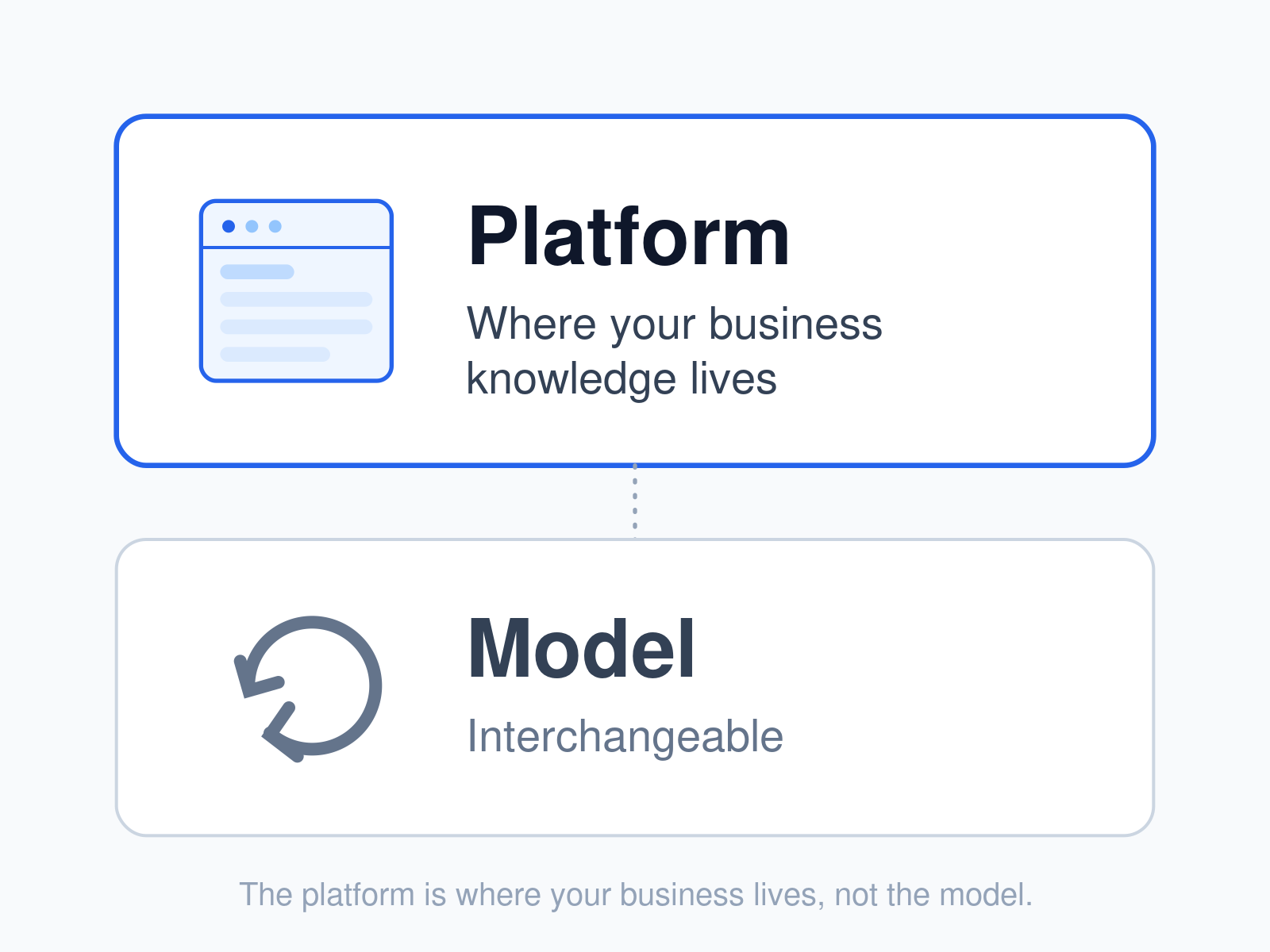
A platform gives your business a home. A model helps you work faster inside it. Confusing those two is where most small business AI plans fall apart.
Here is the objection I hear most: why not just have Claude build me a custom system? You can, and it is easier than it has ever been. But the moment that system exists, you own all of it. Hosting, security patches, updates, the bug that surfaces at the worst possible time. For a business without a technical team, you have not bought a system. You have adopted one.
The better move, in practice: pick a supported platform and use the model to shape it to exactly how your business runs. This is where the two pieces stop competing and start working together.
Say you run a small manufacturing shop and want one place for internal resources, SOPs, client records, and inventory. Use Claude to design the database structure, write the SOP templates, draft the automations, and connect it all inside Airtable or Notion. What used to require an advisor and six months now takes a focused week. When it is done, everything lives in a system you control: permissioned, exportable, supported by a real company, and independent of whichever model helped you build it. Your knowledge accumulates in a system you own, and the model stays a swappable part.
One more thing worth saying plainly. The biggest data risk for a small business right now is not a model provider stealing your secrets. It is employees pasting client information into free chatbots because you never gave them anywhere better to work. A platform fixes that too. When your team has a system that holds the client records and the SOPs, sensitive material stays inside the company tools you chose, with permissions and rules your team understands. The model gets connected on business terms instead of consumer ones.
So the question is not which model to pick. Models change quarterly, and betting your operation on one is how you end up renting your own business back. The right AI platform for a small business is judged on different terms: where your knowledge lives, who controls it, and what happens if you switch tools tomorrow. If the answer is anything more than a subscription, it is worth fixing. And if you want help figuring out which platform fits how your business actually runs, that is exactly what a 15-minute intro call is for.