By Joshua Ross
A couple of years into building up2speed, my technology services business, we had the opportunity to acquire another company. During negotiations, the owner asked me a question I wasn't expecting: "What happens to up2speed if you get hit by a bus?"
I knew the answer immediately. The business would go under. Every key client relationship ran through me. I made every major decision. The processes that kept things moving lived in my head, not in a system anyone else could follow.
That question changed the way I built the company.
Most small business owners don't think about this until they're getting ready to sell. By then, it's often too late to fix. But here's the part that catches people off guard: buyers think about it from the very first conversation. When a buyer evaluates a business, one of the first things they assess is what happens when the owner walks away. The more the answer is "things fall apart," the less they're willing to pay. Industry data shows that owner-dependent businesses typically receive a 10 to 25 percent discount on valuation, and in severe cases, that discount can reach 50 percent.
The way I think about it, there are four levels of owner involvement, and each one tells a buyer something different about risk.
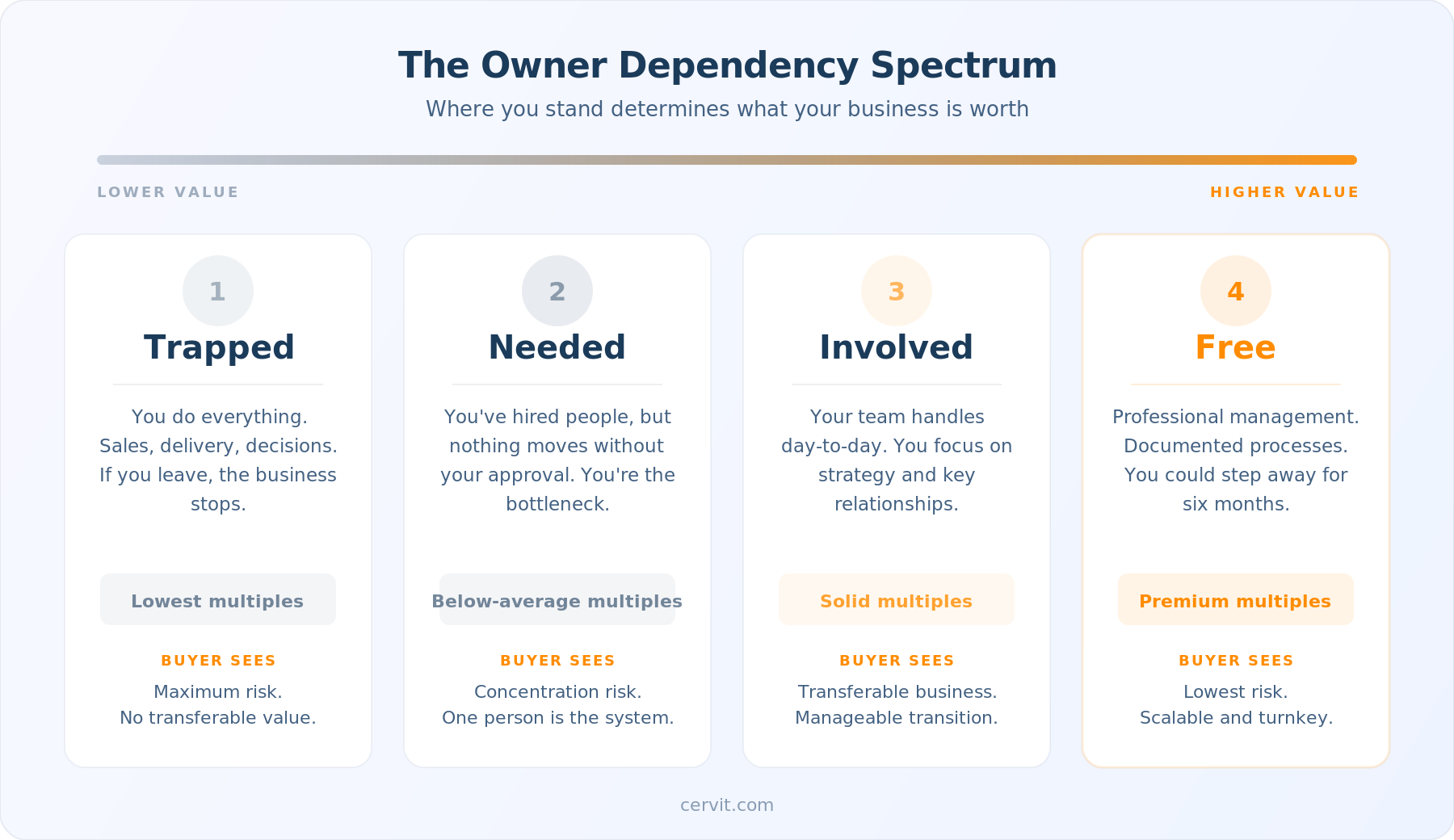
The first level is Trapped. The business is you. You sell, you deliver, you manage, you decide. If you take a month off, revenue stops. This is where most owner-operated businesses start, and many stay here longer than they realize — it's especially common among plumbing, electrical, and graphic design studios where the founder holds the license, the key relationships, or the creative vision. Buyers see maximum risk, and multiples reflect it.
The second is Needed. You've hired people, but nothing moves without your approval. You're the manager of everything. Buyers see concentration risk: one person is still the bottleneck, even if they're not doing all the work.
The third is Involved. You have a team handling operations. You focus on strategy, key relationships, maybe the larger deals. The business functions when you're on vacation, but you're still the strategic driver. Buyers start to see a transferable business at this stage.
The fourth is Free. Professional management, documented processes, customer relationships that belong to the company and not one person. You could step away for six months and performance holds. Research shows that businesses where the owner works fewer than ten hours per week command premium multiples, often a half to three-quarters of a turn higher than their owner-dependent counterparts. This is where the best HVAC companies and roofing businesses operate when they command premium exits.
When that owner asked me the bus question, I wasn't thinking about selling. I was thinking about what would happen to my employees and clients if something happened to me. But the work I did after that conversation, building process, documenting decisions, distributing relationships across the team, is exactly what made up2speed a business someone wanted to buy. The exit wasn't the goal. Resilience was. The exit was a byproduct.
Most owners I talk to know intuitively where they fall on this spectrum. The harder question is whether they're willing to do the work to move up it. That work takes time: typically one to three years of deliberate effort to move from Trapped or Needed toward Involved or Free. It means letting go of control in places that feel uncomfortable. It means trusting people and systems more than your own instincts.
If you stepped away from your business for 90 days, what would happen? Your answer tells you more about your valuation than any spreadsheet.