By Joshua Ross
When I sold up2speed, I assumed the proprietary software we had built to run the business, manage customers, and deploy websites would be interesting to potential buyers, a value, what set us apart. We had invested years developing it. It was custom, it was ours, and it provided efficiencies allowing us to scale - plus there were potential commercialization opportunities.
The buyers we met with barely asked about it. What they wanted to know was how much revenue came in every month from contracts and subscriptions without anyone having to do anything new. They wanted to understand the team, the processes, and whether the business would keep running the same way after I left. The thing I felt had material value was not discussed.
That gap between what sellers think is valuable and what buyers actually care about is a common blind spot in small business sales. It feels similar to selling a house: sellers focus on the memories, money spent, the blood, sweat, and tears. Buyers focus on comparable sales in the neighborhood, the tax basis, schools, and the rental yield potential. Measurable. Comparable. Predictable.
A buyer is trying to answer one question: what happens to the cash flow after I sign? How does it impact the ability to operate the business, make payroll, pay rent? Everything they evaluate filters through that lens. Not "is this business impressive?" but "is this business predictable?" Predictability reduces risk. Reduced risk means a higher price and better terms.
Here's what they're actually looking at.
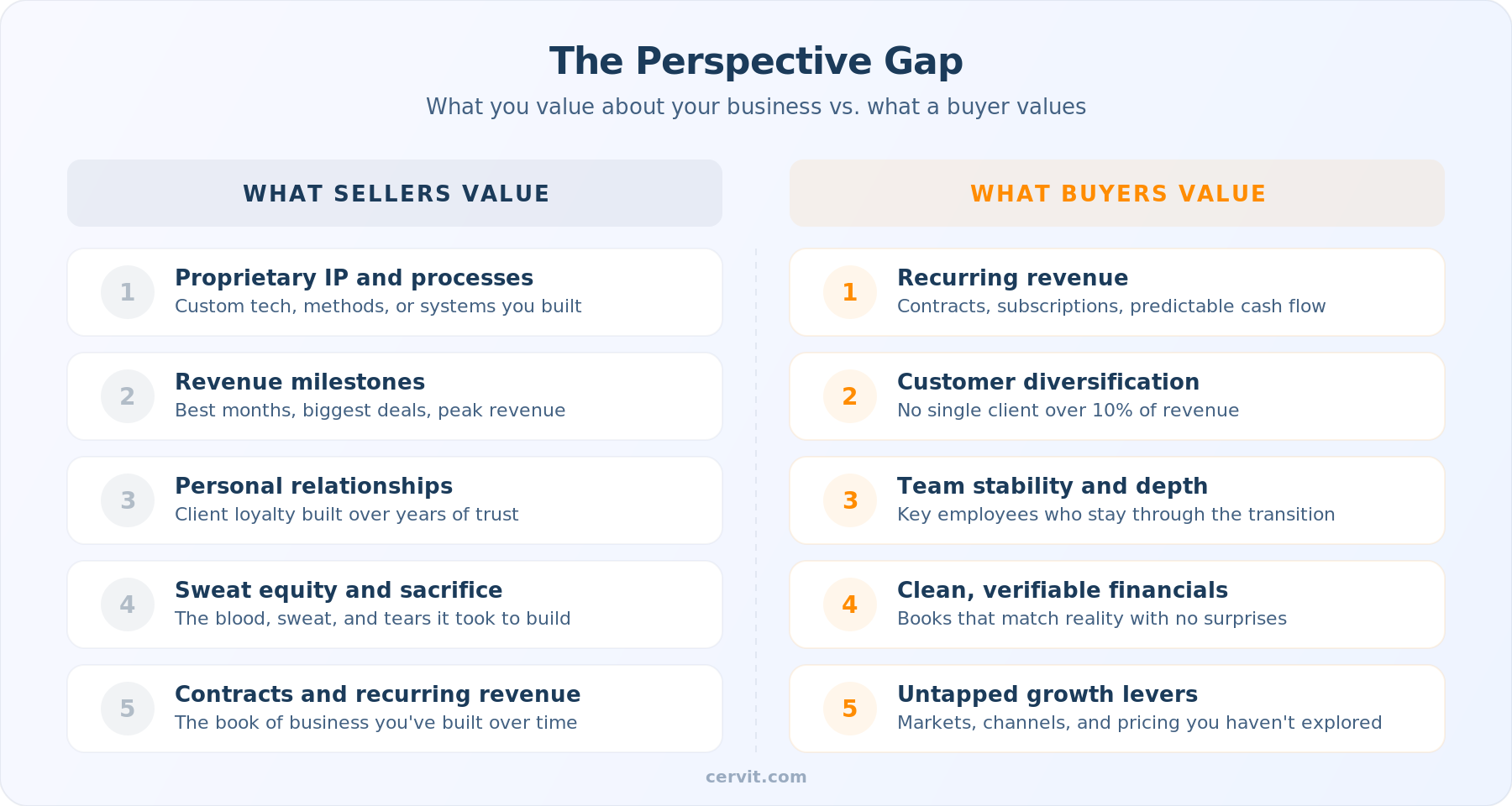
Revenue predictability comes first. Buyers want to see recurring revenue: contracts, subscriptions, retainers, anything that creates a reliable baseline. A business doing $1 million in project-based or one-time sales revenue is worth less than one doing $800,000 in recurring revenue, because the buyer knows what next month looks like. They're not buying your best month. They're buying your worst month and hoping it's close to your average. This is exactly why HVAC companies with strong maintenance agreements and landscaping businesses with commercial contracts tend to command higher multiples than their project-heavy peers.
Customer diversification is next. If one client represents 10 percent or more of your revenue, that's not a customer, that's a dependency. Early on at up2speed, we had a customer that represented 25 percent of our revenue. It kept me up at night. By the time I sold, they were less than 1 percent. Buyers know that relationships can be fragile and uncertain during ownership transitions. Losing a large client post-sale can turn a good deal into a bad one. The more distributed your revenue base, the more confident a buyer feels. This dynamic hits marketing agencies and IT service businesses especially hard — any single client above 20-25% of revenue often shows up as a concentration discount in the offer.
Team stability, experience, and skillset are critical. Buyers ask: will key employees stay after the sale? Do they have reasons to? Are they documented on processes or do they carry institutional knowledge in their heads? A strong team that stays through a transition is one of the most undervalued assets in a small business sale.
Clean financials seem obvious, but over 40 percent of small business acquisitions surface financial discrepancies during due diligence. When a buyer finds something that doesn't match what they were told, even something small, trust shifts. They stop evaluating the opportunity and start looking for what else is hidden. Transparency is not just good practice. It's a valuation lever. Start the audit and cleanup process early. It takes longer than most owners expect, and an experienced accountant can move the multiple.
Operational documentation and processes. Can someone who has never worked in your business understand how it runs by reading what you've written down? If the answer is no, the buyer is pricing in the cost of figuring it out on their own, and they'll discount accordingly. At up2speed, we built a wiki that tracked every customer, process, and procedure and was updated daily. That kind of operational clarity signals a business that runs on systems, not memory which reduces dependency on the owner and employees.
There's one more thing buyers look at that most sellers overlook: growth levers that haven't been pulled. New markets you haven't entered. Customer segments you haven't targeted. Pricing you haven't optimized. Marketing channels you never invested in. Technology you haven't leveraged. These represent upside a buyer can capture, and they make a business more attractive because there's room to grow without reinventing the model. A business with clear, untapped opportunities gives them a reason to pay more.
The reality is that buyers are not looking for perfection. They're looking for clarity + opportunity. A business with clean books, predictable revenue, a stable team, and documented operations tells the buyer: this is a business that works, and it will keep working after the sale.
If a buyer walked through your business tomorrow, what would they see? Not what you would tell them, what they'd find on their own.