By Joshua Ross
If your HVAC business generates $800K in revenue but produces $220K in SDE, a buyer at a 3x multiple is paying $660K. Not $800K.
Revenue doesn't drive the value of your business, seller's discretionary earnings (SDE) does.
SDE is the primary metric buyers used to value most owner-operated businesses. You start with net income, then add back owner salary, personal benefits, interest, depreciation, amortization, and one-time or non-recurring expenses. That gives a normalized view of what the business actually earns. Then a buyer applies a multiple:
- $300K at 3x = $900K
- $300K at 4x = $1.2M
Same earnings. Different outcome. SDE tells a buyer what the business earns. The multiple determines what they're willing to pay.
There are only two ways to increase what a buyer will offer: increase SDE or increase the multiple. Most owners focus on the first. They grow revenue, add services, take on larger clients. Sometimes that works. Sometimes it adds volatility, complexity, and dependence on them. Not all growth is equal:
- $1 of recurring revenue > $1 of project revenue
- $1 across 50 customers > $1 from one
- $1 that runs without you > $1 that depends on you
Most owners don't find out which kind of revenue they have been building until a broker values their business. By then, the choices that shaped that number are years old. Knowing earlier in the process gives you time to change them.
The multiple is where the second lever lives, and it reflects risk. Buyers look at revenue predictability, customer concentration, owner dependency, and the quality of your financials. One client at 25% of revenue feels like a win until you're in due diligence explaining why a buyer shouldn't discount your entire valuation. Two businesses with the same SDE can sell at very different prices because one is predictable and transferable, and the other isn't.
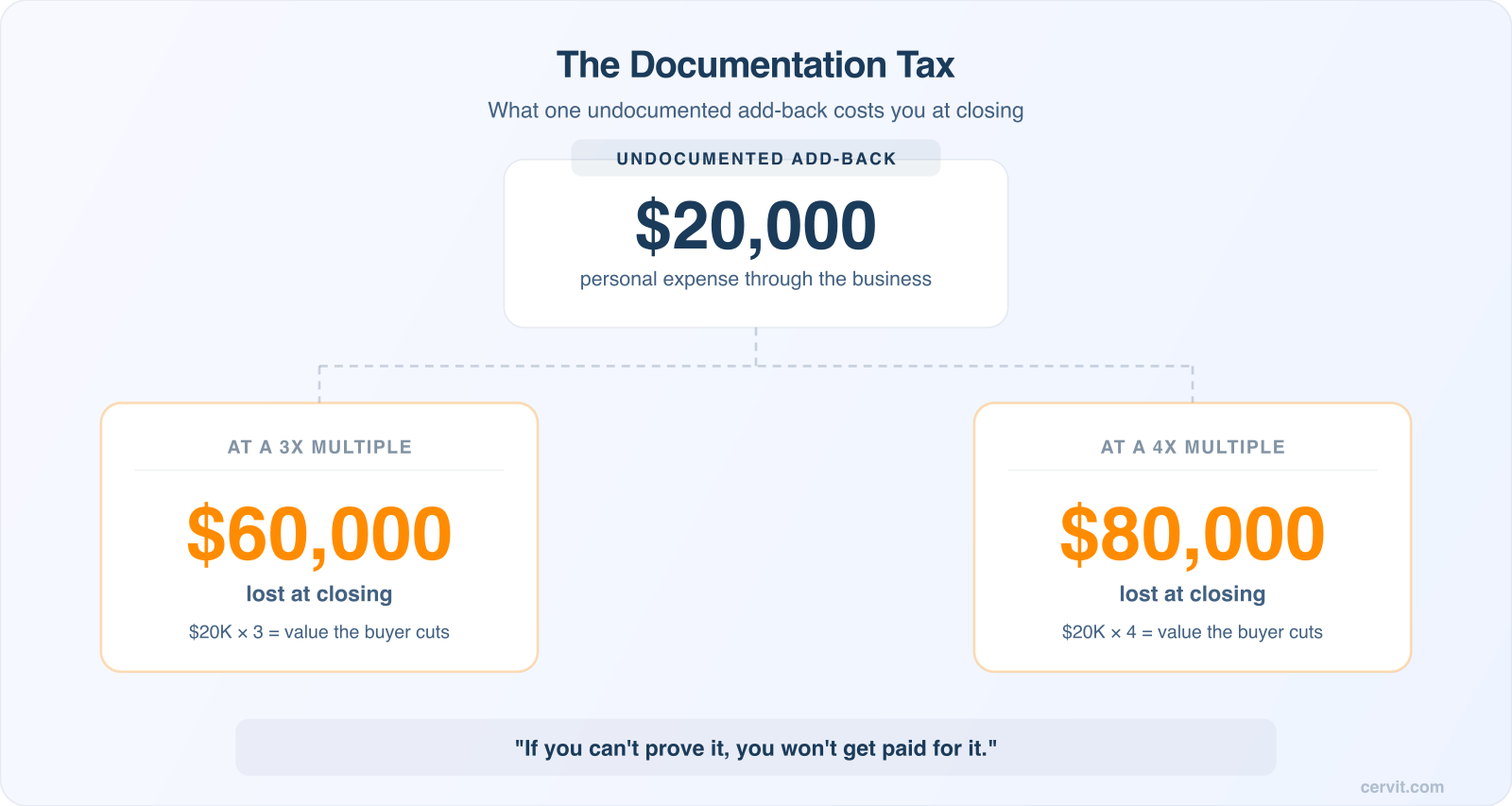
I have talked to several owners who have left significant $$$ on the table at closing. Not because their business wasn't worth it, but because they couldn't prove what they were adding back. Running personal expenses through the business is common practice. The issue is documentation. Every dollar added back to SDE gets multiplied: $20K at 3x is $60K; at 4x it's $80K. That value only exists if the add-back holds up, accepted by the buyer. If it's unclear, inconsistent, or undocumented, a buyer will cut it. By the time most owners find out, they're already in the process. You can't go back and document two years of add-backs after the fact. If you can't prove it, you won't get paid for it.
Most owners I talk to don't know their SDE. They also don't know what it's costing them. Cervit was built to change that. In a few minutes, you can see your SDE, what's driving your multiple, and where to improve it. Find out what your business is worth.