By Joshua Ross
My first AI expense was $20 a month. Then it was $200. Now it depends on how many people run my valuation agent and how hard it works, and I do not know the number until the bill arrives.
That is what a variable cost looks like.
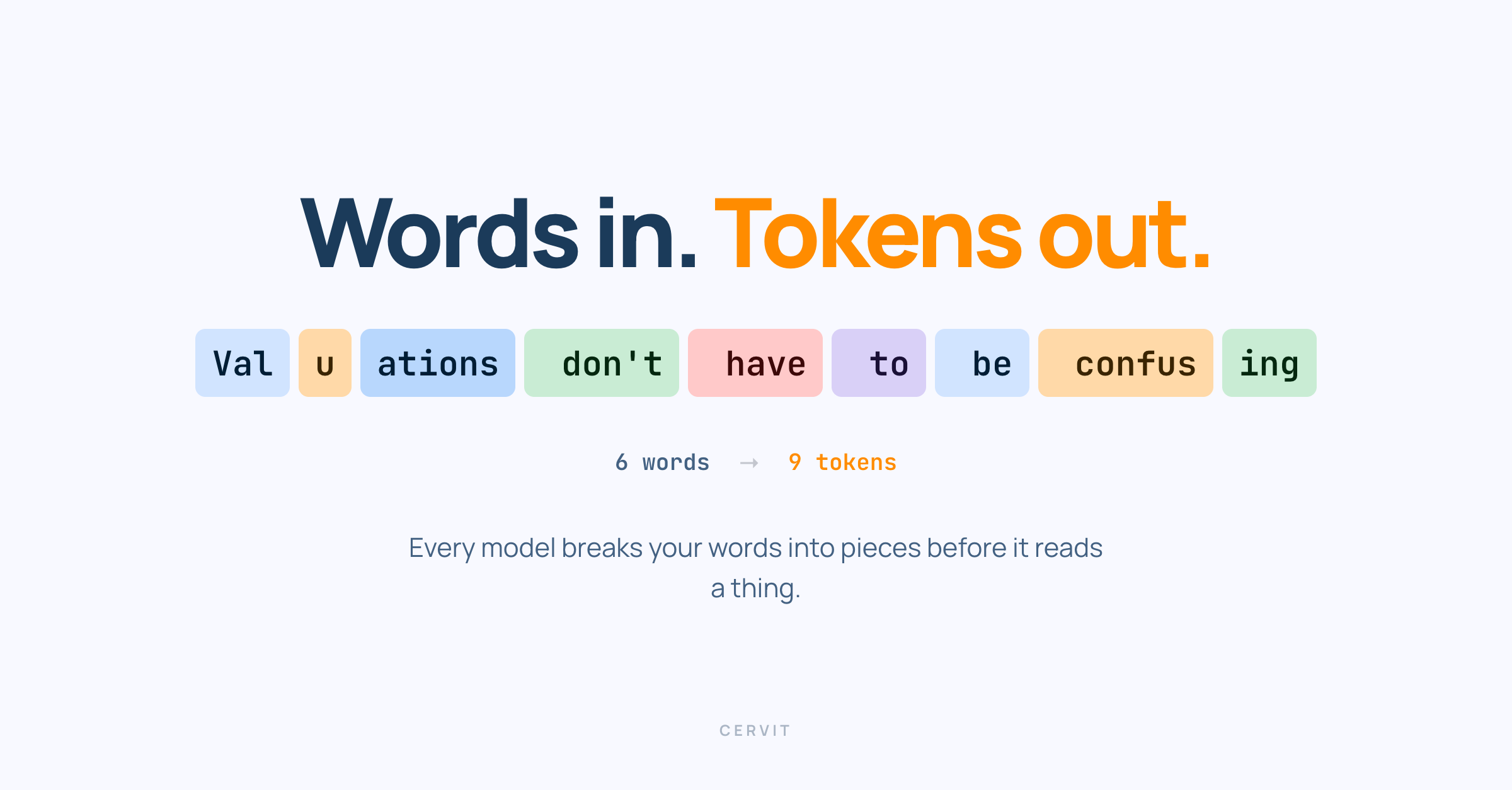
AI looks like software but it behaves like a utility. Every time a model reads or writes something, a meter is running. The unit is a token: a word, part of a word, or punctuation mark. Roughly 75 English words equals 100 tokens. You can see it for yourself in OpenAI's tokenizer. The prompt counts, but so do previous messages, uploaded documents, system instructions, and the response itself. All of it adds to the bill.
Most businesses start with a $20 subscription. An employee buys ChatGPT or Claude, submits the expense, and the company adds another fixed line item. The cost stays predictable but the plan limits how much the person can use. Hit the limit and the tool stops working, or the employee starts rationing.
When AI becomes part of a product or workflow, the pricing model shifts and the costs become material. An API lets software send requests and receive responses without someone monitoring the process. The business pays per token, usually at different rates for what goes in and what comes out. At current OpenAI pricing, 10,000 input tokens and 2,000 output tokens costs about 11 cents. Run that a hundred times, add long documents, or let an agent retry its work, and the math changes fast.
That progression was not a plan. On the Pro subscription the expense was fixed, but I kept hitting usage limits while I was building a business valuation agent, so I moved up a tier for the capacity. To be honest, I never went back. The finished agent is web facing, available to everyone, and runs on an API instead of my personal subscription. It reviews financials, conducts research, and produces a valuation. Every document, revision, and report adds to the cost, and I am not the one deciding how often that happens.
This is the shift most businesses will face: AI moves from a fixed subscription to a variable cost that scales with use. A website analyzes a customer submission. An automation reads an intake form and updates the CRM. A support system drafts responses from company documents. The meter runs in the background, even when nobody is watching.
The mistake is managing that cost the same way you manage software.
Nufar Gaspar offers a useful way to sort it. Every token either teaches, produces, or spins. She walks through the idea on The AI Daily Brief. Teaching means researching, building instructions, testing workflows, and learning what AI can do. Producing means completing valuable work: a proposal, a reconciled account, a customer answer, a valuation. Spinning means consuming tokens without meaningfully improving the result.
Spinning is the one worth watching. Suppose my valuation agent is told to research comparable businesses with no clear stopping point. It searches more sources, summarizes the same information three different ways, carries a growing research history into every new request, and keeps looking because no comparison is ever perfect. The cost climbs. The valuation does not improve. And it keeps charging my card until I notice or set a cap.
Nobody asks an agent to spin. It happens because the instructions define the task without defining when it is done. "Research the market thoroughly" sounds reasonable. "Review five credible sources, document gaps, and stop after two unsuccessful searches" gives the agent a boundary.
Larger companies hit this first. Meta ran an internal competition around token usage. Uber encouraged broad experimentation and reportedly consumed its annual AI budget in four months (Associated Press, TechCrunch). The instinct was reasonable. People need permission to experiment before a company can find where AI creates value. The mistake is letting consumption remain the measure of progress after the learning stage ends.
For a small business, the goal is not to use the most tokens or the fewest. Start by identifying every AI subscription and API expense. Then ask what the spending is teaching, what it is producing, and where it may be spinning.
Usage is easy to measure. Value requires more thought.
If you cannot answer those three questions for your own business, that is where to start. Book a 15 minute intro call.